









South Vietnamese President Ngo Dinh Diem was overthrown in a military coup on November 1, 1963, after months of political and religious unrest and growing tensions with the United States. Diem and his brother Ngo Dinh Nhu were captured and assassinated the following day, plunging South Vietnam into a period of political instability at a critical moment in the Vietnam War.
By the early 1960s, South Vietnam was a nation under siege—not only from the communist insurgency spreading through its countryside, but from growing unrest within its own government.
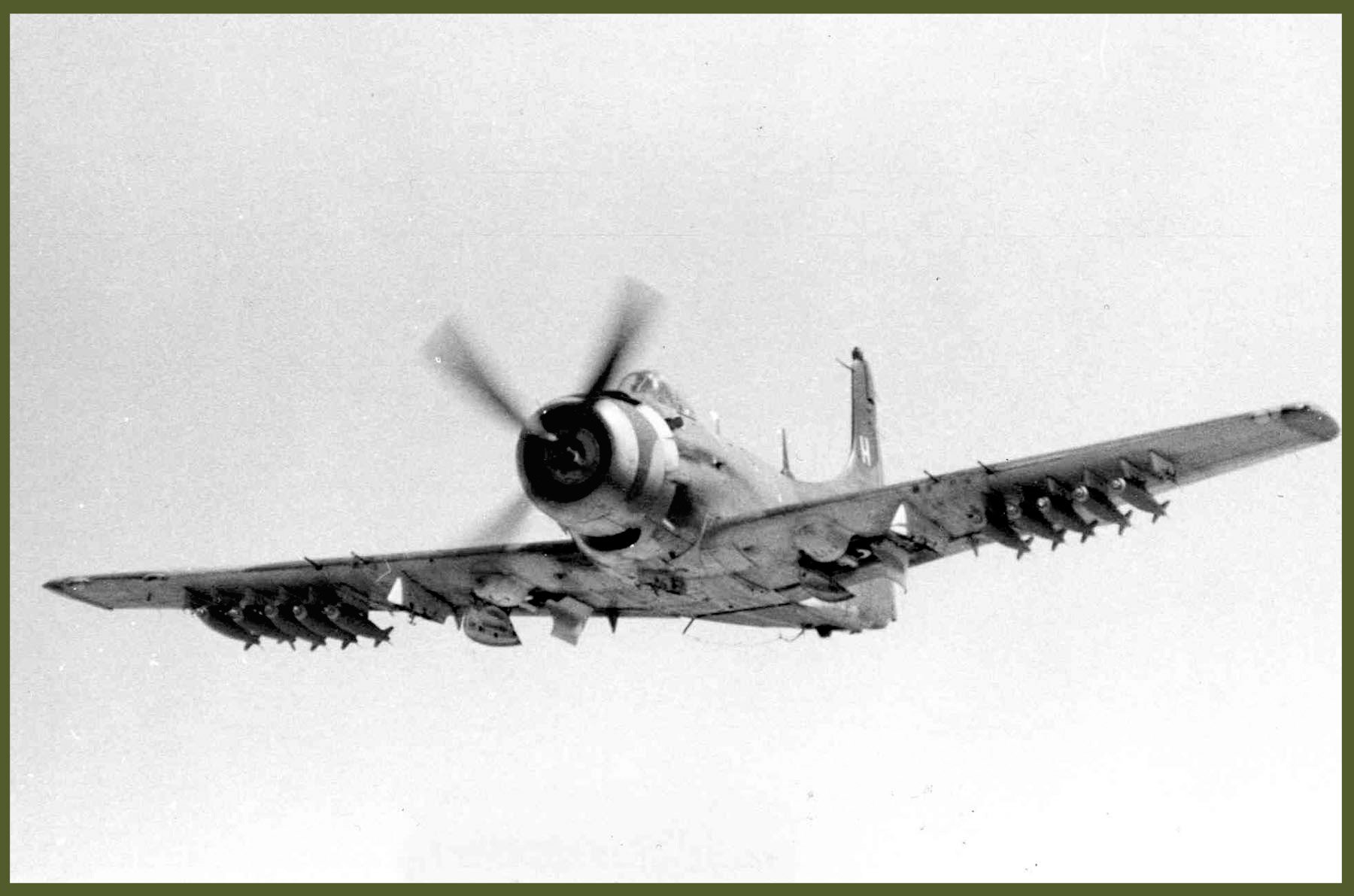
The first warning came in November 1960, when Lieutenant Colonel Vuong Van Dong led an attempted military coup against President Ngo Dinh Diem. The rebellion failed, but it exposed dangerous cracks in the regime. Two years later, in February 1962, Diem narrowly escaped death when two renegade South Vietnamese Air Force pilots bombed and strafed the Presidential Palace in Saigon. The attack left parts of the palace in ruins, yet Diem and his family survived.
Douglas A-1H Skyraider of the Vietnamese Air Force, same plane used by the South Vietnamese Air Force pilots! (Credit / source Wikipedia work of US Air Force employee)
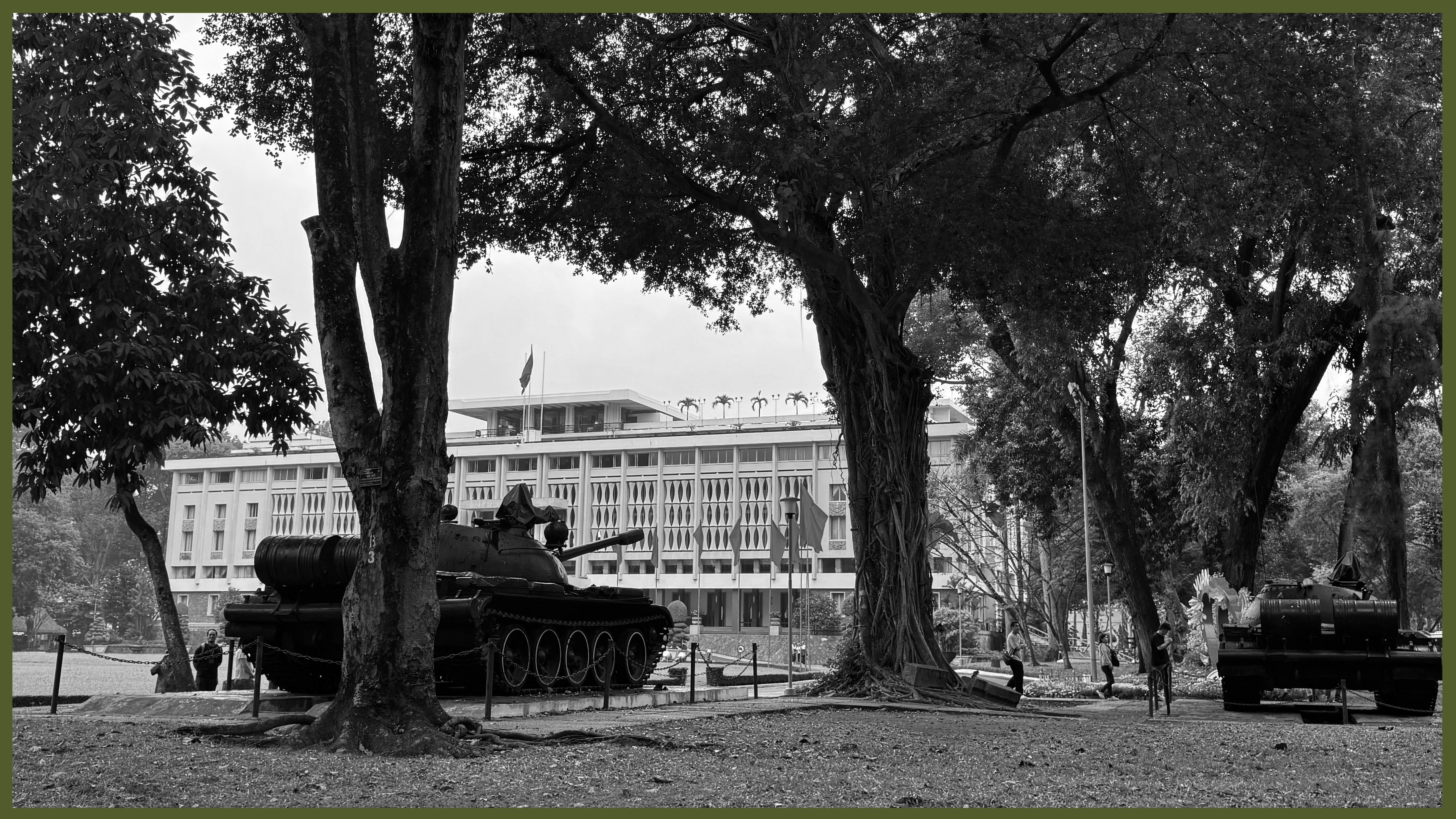
Presidential Palace Saigon (Ho Chi Minh) by Rudy of Vietnam American Heroes
As 1962 drew to a close, American officials in both Saigon and Washington believed the tide of war might finally be turning. Massive US military aid was flowing into South Vietnam, and American advisers were eager to prove that the Army of the Republic of Vietnam (ARVN), armed and trained by the United States, could defeat the Viet Cong.
Their opportunity arrived on January 2, 1963, near the small Mekong Delta village of Ap Bac.
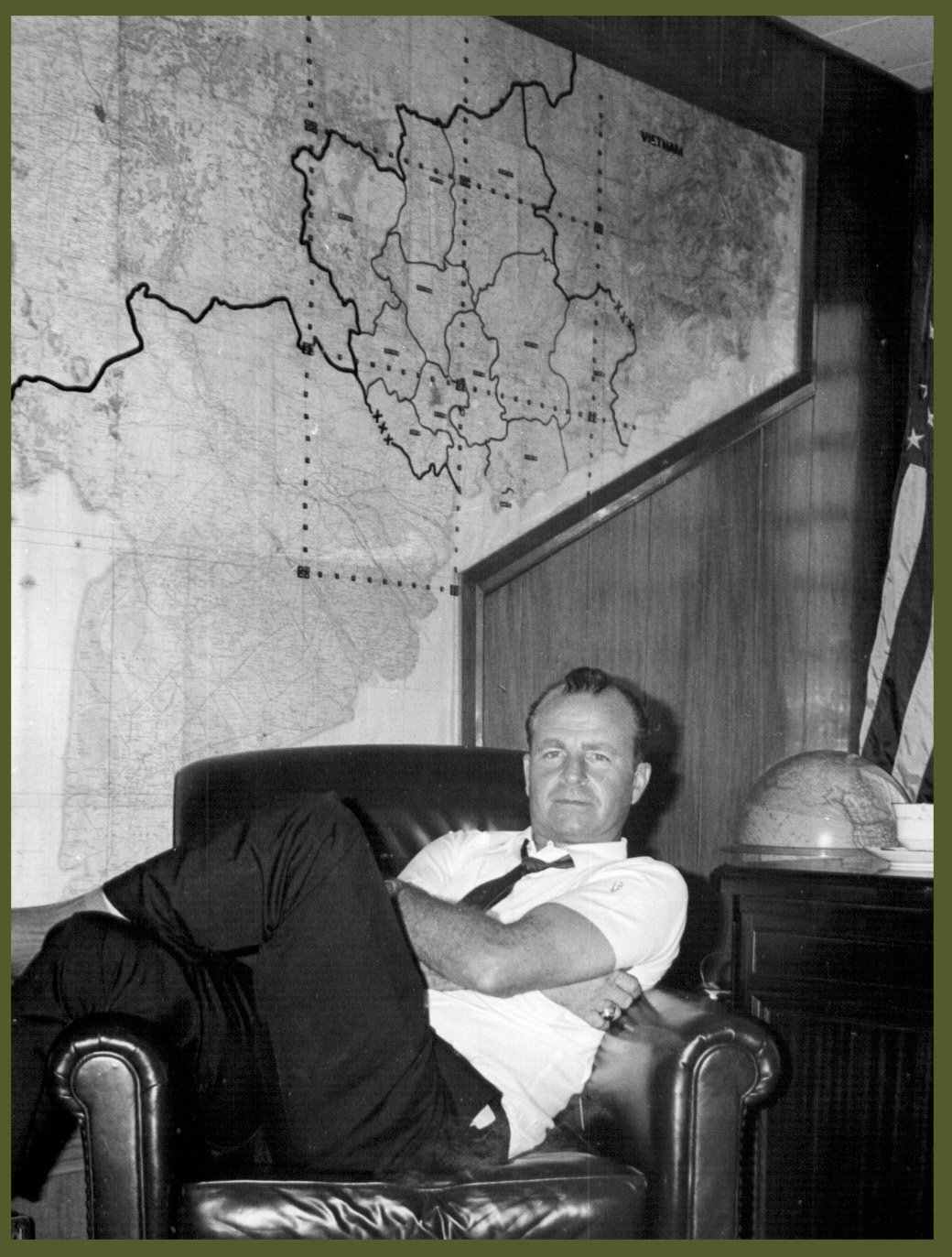
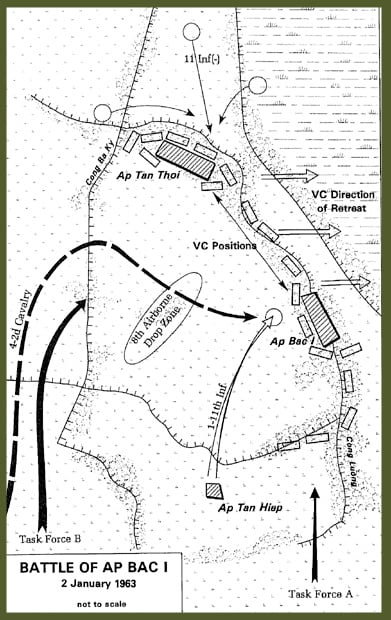
South Vietnamese intelligence had reported that several companies of Viet Cong fighters were concentrated in the area. Lieutenant Colonel John Paul Vann, one of the most respected American advisers in Vietnam, urged ARVN commanders to launch a bold encirclement operation. Helicopter-borne infantry would attack from the north, infantry battalions would advance from the south, and armored personnel carriers would close in from the west. Artillery and aircraft stood ready to support the assault.
John Paul Vann in office in Saigon (Credit / source Wikipedia work of a United States Department of State employee)
On paper, the Viet Cong appeared trapped.
Reality proved very different.
Despite repeated warnings from Vann, ARVN commander Colonel Bui Dinh Dam delayed the attack for nearly twenty-four crucial hours. The delay allowed the Viet Cong to prepare defensive positions and carefully conceal themselves among the rice paddies and tree lines surrounding the village.
As helicopters descended with fresh troops, the waiting guerrillas suddenly opened fire. The sky erupted in chaos. Helicopters were riddled with bullets and crashed into the fields below. By midday, five American helicopters had been shot down, and stranded crews were fighting for survival.
Frustrated and furious, Vann spent hours trying to persuade South Vietnamese commanders to launch rescue operations. When armored vehicles finally moved forward, they advanced so cautiously that they became easy targets. Elsewhere, infantry units refused to press their attacks. A planned airborne deployment intended to block the Viet Cong escape route was dropped in the wrong location. As darkness fell, friendly forces mistakenly fired on their own paratroopers, creating confusion and panic.
Amid the disorder, the Viet Cong quietly slipped away.
The Battle of Ap Bac was a stunning embarrassment. It exposed weaknesses in South Vietnam's military leadership and shattered American confidence in Diem's government.
Map of Ap Bac battle (Credit / source Wikipedia materials that originally came from the United States Army Center of Military History)
Meanwhile, political unrest was spreading across the country. Diem's Strategic Hamlet Program, designed to isolate rural villagers from communist influence, was proving ineffective. Buddhist protests against government discrimination intensified, and calls for reform echoed through the streets of Saigon and Hue.
Even Diem's closest allies were losing faith.
On August 21, 1963, security forces loyal to Diem's brother, Ngo Dinh Nhu, raided Buddhist temples across South Vietnam. The violent crackdown outraged both Vietnamese citizens and international observers. Just two days later, ARVN Chief of Staff General Tran Van Don secretly informed CIA officer Lucien Conein that senior military leaders were preparing a coup.
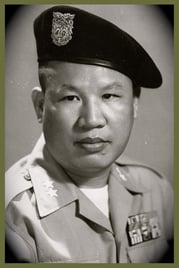
ARVN General Pham van Dong, Military Governor of Saigon 1965 (Credit / source Wikipedia official photographer of the AFRVN, collection of the Pham family)
The generals wanted assurance that the United States would support them.
In Washington, debate raged within President John F. Kennedy's administration. Finally, on August 26, the newly appointed US ambassador to South Vietnam, Henry Cabot Lodge Jr., was authorized to tell the plotters that while America would not actively participate in a coup, it would support a new government if one emerged.
For the generals, that was enough.
On November 1, 1963, army and airborne units surrounded the Presidential Palace in Saigon. Loyal guards prepared to fight, but Diem found little support. Calls to General Don and Ambassador Lodge brought no reassurance.
Refusing to surrender, Diem and his brother Nhu escaped through secret passages and fled into the city. Their freedom was brief. Captured the following morning, they were promised safe passage into exile. Instead, both men were murdered in the back of an armored personnel carrier on November 2, 1963.
The brothers were buried in unmarked graves in Saigon's main Catholic cemetery.
The news shocked President Kennedy. Although his administration had encouraged support for the coup, the brutal assassination horrified him.
Just three weeks later, tragedy struck again!
President and Mrs. Kennedy arrive at Dallas, Texas (Credit / source NARA)
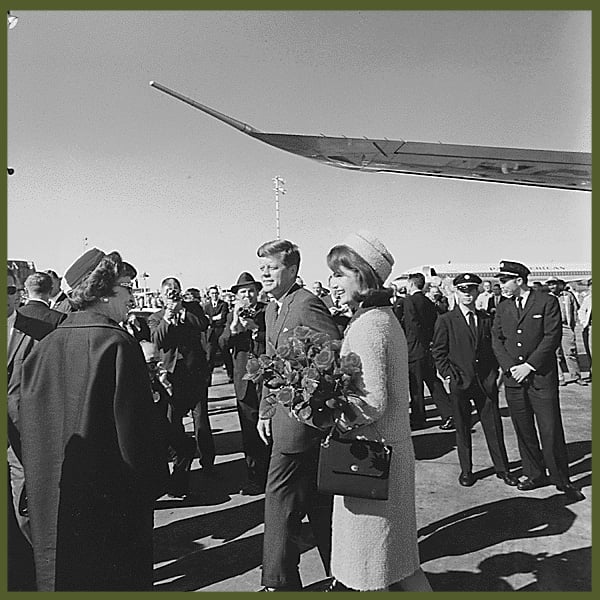
On November 22, 1963, Kennedy himself was assassinated in Dallas, Texas, when Lee Harvey Oswald fired upon the presidential motorcade.
Vice President Lyndon B. Johnson suddenly found himself leading the United States. One of his first foreign policy decisions was to reaffirm America's commitment to South Vietnam. Johnson privately vowed that he would not be remembered as the president who "lost Vietnam."
Yet Diem's removal failed to bring stability.
Instead, South Vietnam descended into political chaos. Between 1963 and 1965, a succession of military coups and short-lived governments followed one another in rapid succession. Twelve different administrations rose and fell as generals competed for power.
The Viet Cong seized the opportunity, expanding their influence and launching increasingly effective attacks across the countryside.
Finally, in 1965, General Nguyen Van Thieu emerged as South Vietnam's dominant leader. He would remain president for the next decade, presiding over a nation increasingly dependent on American military support as the war entered its most destructive phase.
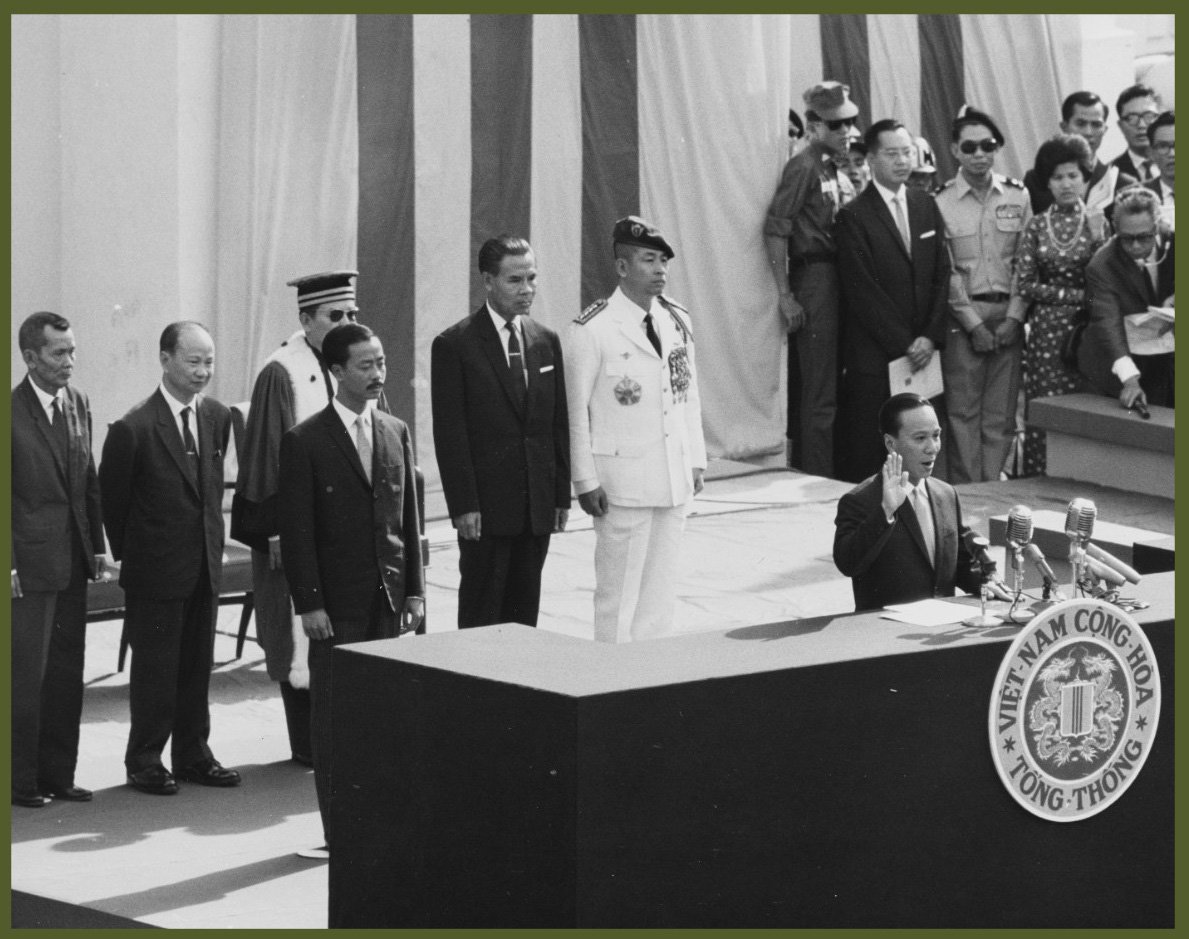
Nguyễn Văn Thiệu having taken part in the coup d'état against President Diem in November 1963, made a rapid rise to power, becoming Prime Minister and then President of the Southern Republic in 1967. He resigned on 21 April 1975 and then fled the country before passing away in Boston, 2001.
Nguyễn Văn Thiệu takes the oath of office, 31 October 1967 (Credit / source Wikipedia work of a sailor or employee of the U.S. Navy)
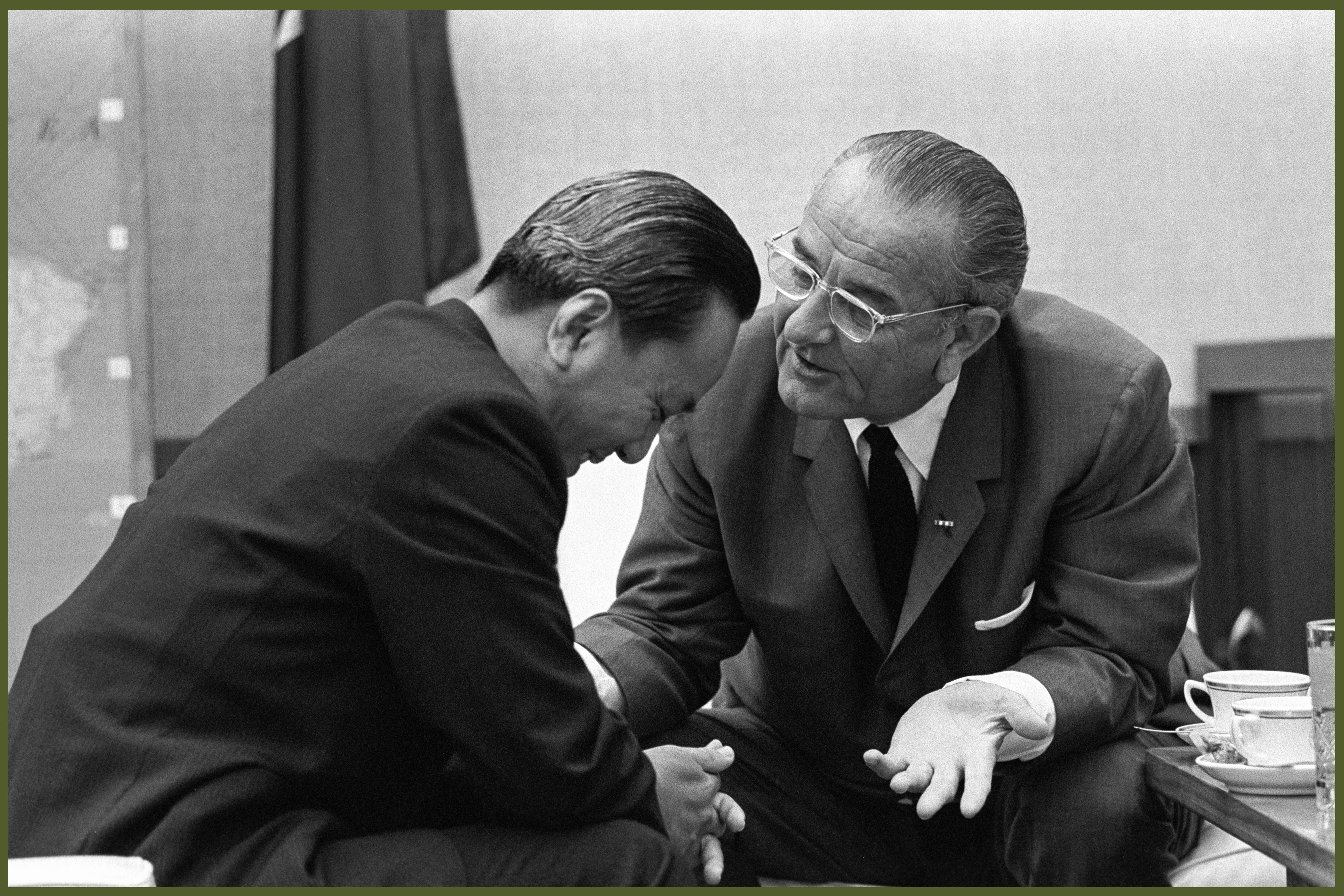
Lyndon B. Johnson meeting with President Nguyễn Văn Thiệu in Hawaii - 1968 (Credit / source Wikipedia work prepared by an officer or employee of the United States Federal Government)
The assassination of Ngo Dinh Diem was intended to save South Vietnam. Instead, it opened a new chapter of instability—one that would draw the United States ever deeper into the conflict.